


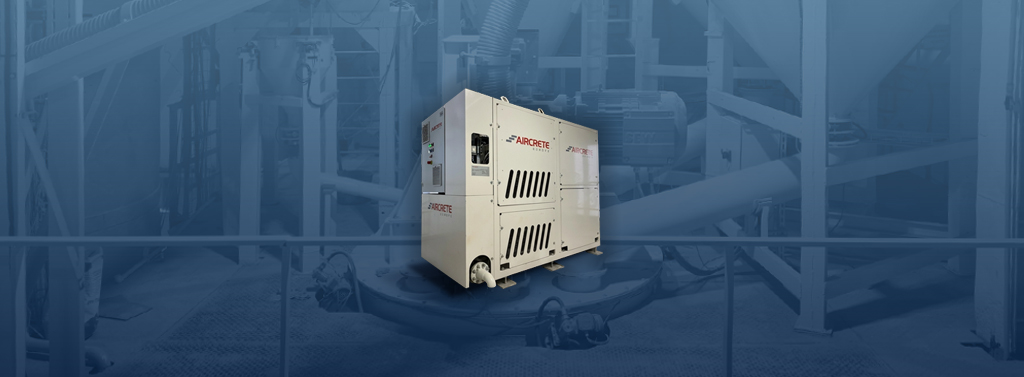

The dual pressure cleaning system: rethinking mixer performance for the AAC industry.
AAC mixers face cleaning demands that standard ready-mix equipment was never designed for: chemically reactive residues, aluminum powder/paste, and a strict thermal window that must be maintained between casting cycles. This article examines the Dual Pressure Cleaning System, a purpose-built platform developed by Aircrete Europe that combines automated, tiered high-pressure cleaning cycles with a dedicated low-pressure flushing circuit, recovering production time that would otherwise be lost to manual maintenance. Drawing on the system’s standard architecture and a real-world deployment example, the article outlines how its configurable cleaning cycles, equipment package, and installation process combine to reduce downtime, cut labor and water costs, and improve operator safety.
Autoclaved aerated concrete (AAC) production places cleaning demands on mixer systems that go well beyond what conventional ready-mix concrete plants ever have to manage. High-pressure cleaning equipment has been available in the past, but it was engineered for ready-mix mixers, which handle nothing more complex than aggregates, cement, admixtures and water. AAC mixers, by contrast, work with far more chemically reactive residues, and that difference is exactly what pushed Aircrete Europe to develop something new: the Dual Pressure Cleaning System, a purpose-built platform with its own machine architecture, control logic, and component structure, designed from the ground up for AAC mixing towers. A second-generation cleaning head, engineered entirely in-house, is already underway to further refine nozzle design and safety features for AAC-specific conditions.
Before looking at how the system works, it is important to understand why it was developed in the first place. The Dual Pressure Cleaning System is not primarily about achieving a level of cleanliness that cannot be reached manually. A skilled crew with a hose and sufficient time can clean a mixer effectively by hand. The real difference is how much time that cleaning requires, and whether production has to stop while it is being done.
Manual cleaning means taking the mixer out of production, with every hour spent on cleaning representing an hour of lost casting time, in addition to the labour required to carry out the task. In a continuous production environment, that lost production time is the real cost of cleaning and the key factor that justifies investment in an automated system. The Dual Pressure Cleaning System changes this equation by moving routine cleaning into the production process itself. Automated cycles can clean the mixer during or between casting cycles, significantly reducing the need for production-stopping manual intervention.
A residue unlike any other
The root of the challenge lies in what AAC mixers actually process: sand slurry, return slurry, cement, lime, gypsum, aluminum powder/paste, and condensate; all of which contribute to a residue that is considerably more complex and reactive than that left behind in standard concrete mixing. Because ready-mix residue isn’t temperature-sensitive, cold water is enough to clean it. AAC residue is a different story. It needs warm water, both to keep material from sticking to internal surfaces and to preserve the mixer’s thermal balance between casting cycles. The target mixing temperature sits at 40–45°C, and if a mixer falls out of that range after downtime, the first batch cast afterward risks being compromised: without enough thermal energy, the aluminum powder/paste can’t generate sufficient rise, and cake quality suffers as a result.
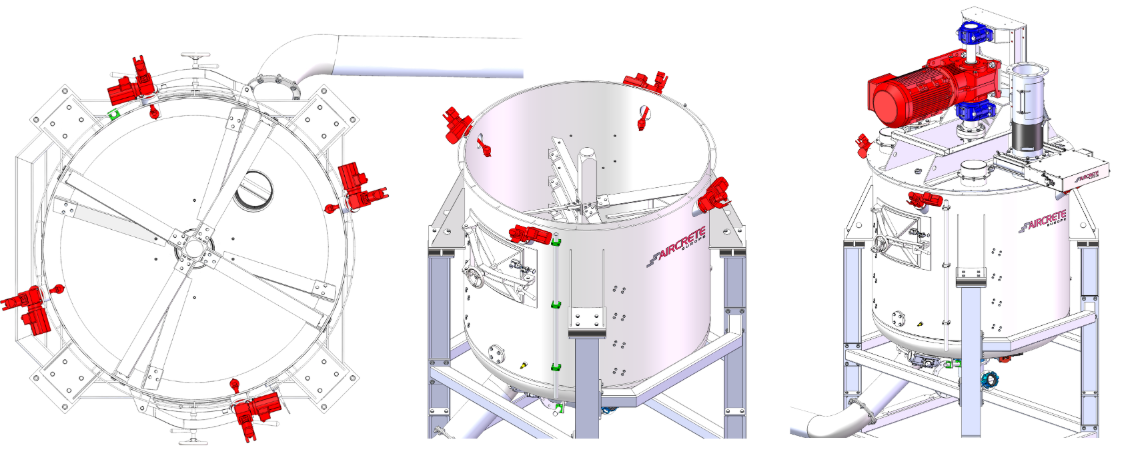
positioning around the AAC mixer.
To manage that thermal and chemical complexity, the Dual Pressure Cleaning System runs through a touchscreen offering three modes: (i) an automatic mode built on pre-programmed setups, (ii) a manual main-setup mode, and (iii) a handheld gun mode for operator-directed spot cleaning. Within the automatic mode, three setups are embedded in the control software, each mapped to a specific stage of the production cycle.
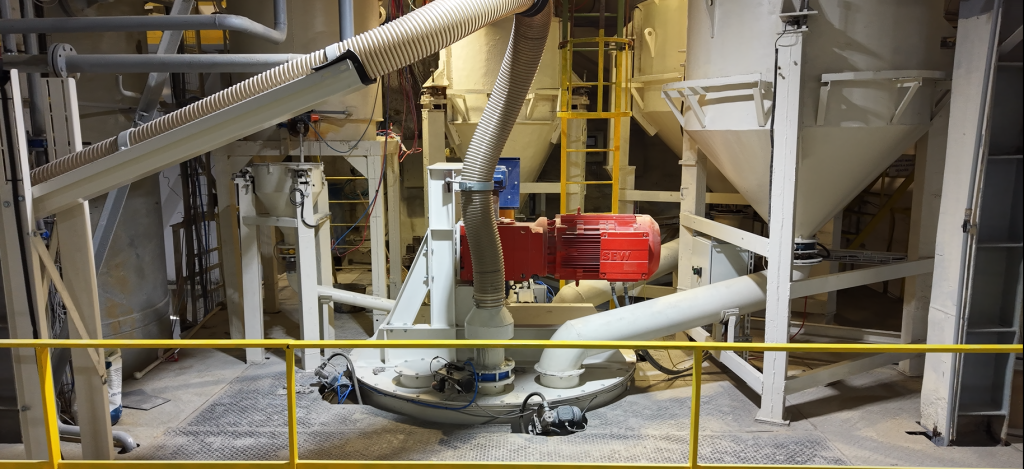
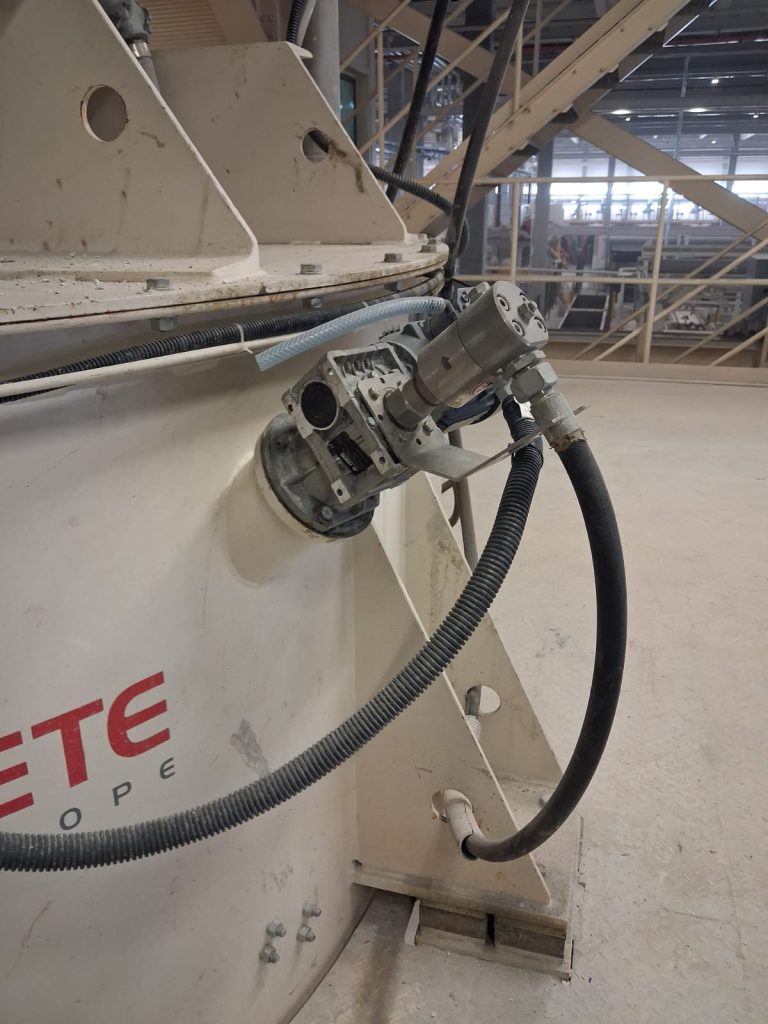
installed on the AAC mixer.
The Flushing Setup runs after every casting, immediately after the mix is discharged. The system runs a short flushing cycle using 30–40 liters of warm water at around 50 bar. This takes only about 12 seconds and removes fresh dust and residue before it has any chance to harden on the mixer walls. Crucially, the flushing water remains in the mixer as part of the slurry for the next batch, so the cleaning is fully integrated into the casting process and does not add any extra cycle time.
The Intermediate Setup provides more intensive cleaning during normal production and is run once per shift or once per day, depending on the plant’s schedule. It uses approximately 200 liters of water at 150–160 bar and takes about two minutes. Its job is twofold: clearing the small buildups that flushing alone cannot remove and, when used after a stoppage, reheating the mixer. At a facility running 24/7, regular use of this set-up, combined with a short manual touch-up using the handheld gun, keeps the mixer clean throughout the week, with approximately ten minutes of manual intervention needed per week.
The Deep-Cleaning Setup is generally not required during normal operation. It is intended for plant shutdowns, such as scheduled maintenance or the end of the working week at plants operating five days a week rather than continuously. Using approximately 600 liters of water at 150–160 bar over about six minutes, it provides a more thorough clean than the flushing and intermediate setups can achieve.
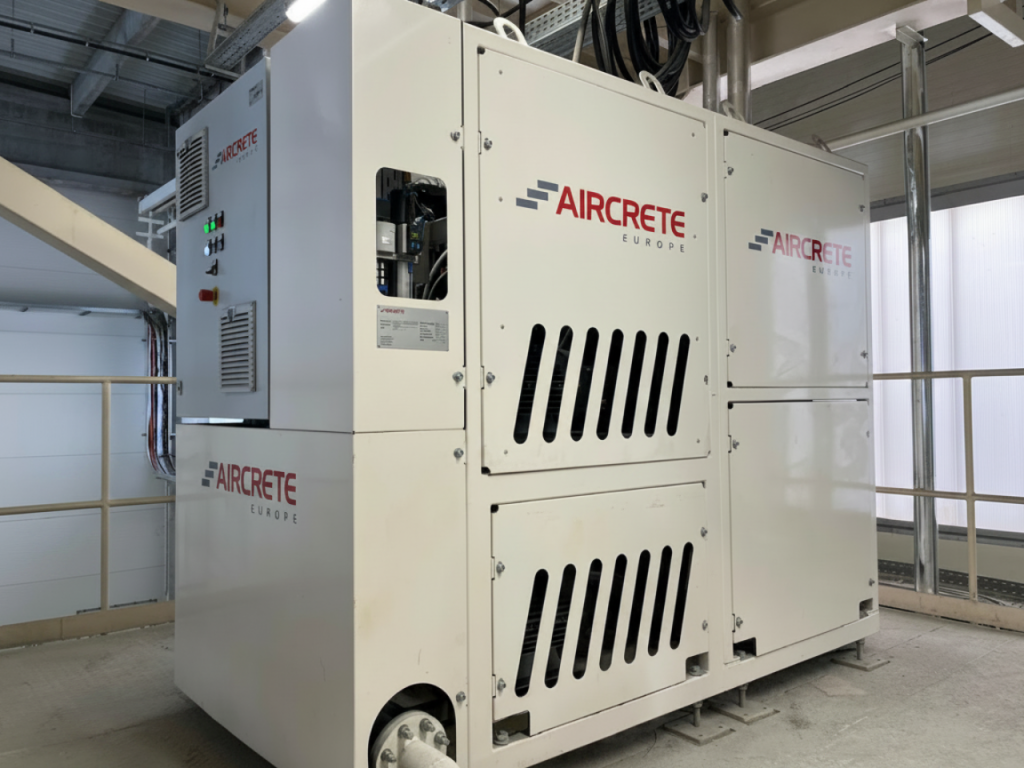
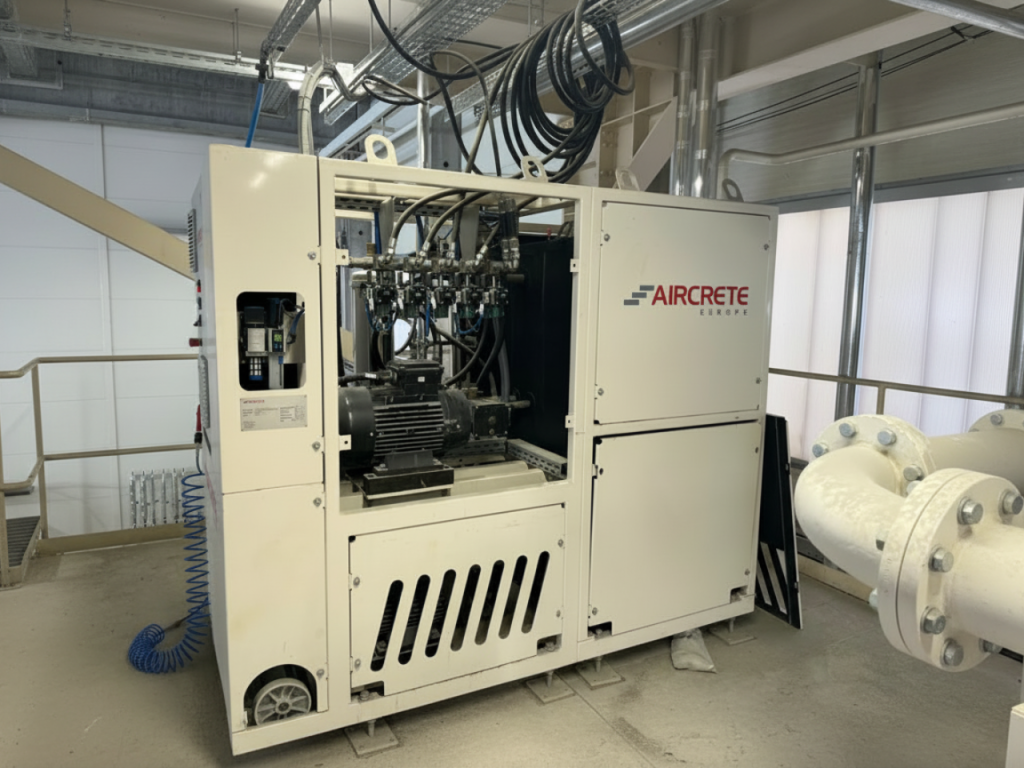
System, showing the equipment enclosure (top)
and the internal pump, heating
and hydraulic components
(bottom).
Warming up without losing a batch
Cleaning isn’t the only reason the mixer needs hot water on demand. Whenever production stops for a few hours, for scheduled maintenance or any other reason, the mixer cools down along with it. Casting into a cold mixer is a problem: without enough thermal energy in the mix, the aluminum powder/paste can’t generate sufficient rise, and that first batch is compromised before it even reaches the mould. Rather than waiting for the mixer to slowly return to temperature on its own, or discarding a substandard first cake, the system’s pre-warming mode circulates hot water through the mixer to bring it back into the 40–45°C operating range before casting resumes. That single function, run right before the first batch after a stop, is what turns a maintenance break into a clean restart instead of a wasted cycle.
Built-in flexibility
What makes this tiered approach so valuable in practice is its flexibility. The three recipes described above (short flushing, 200 L standard deep cleaning, and 600 L very deep cleaning) form the standard configuration, but the system is not limited to just three levels. The flow, pressure, and duration of each cycle can be adjusted in the control software, allowing plants to define several cleaning “tiers” that match their own production schedule and contamination patterns, all while working with warm water in the optimal temperature range for AAC production.
This solution alone was reported to remove almost the entire need for manual cleaning and to recover roughly one hour of production time per 24-hour cycle. Because the recipe software automatically deducts the exact quantity of water used for spraying, there’s no water waste to account for, and because the cycles run without manual intervention, operators are kept clear of the mixer entirely, a meaningful safety gain on its own.
What’s inside the system
Behind that configurability sits a fairly substantial equipment package: high-pressure spraying nozzles pre-installed into mounting flanges, a pair of pumps rated at 22 kW each for a combined capacity of 100 liters per minute, a 32 kW heating element, a 1,200-liter water storage vessel, the associated valves and hydraulic components, pressure sensors, and a stand-alone PLC system with a 7-inch touch panel and frequency inverter. Everything arrives pre-cabled and pre-tested, which keeps on-site engineering, installation, and commissioning work to a minimum.
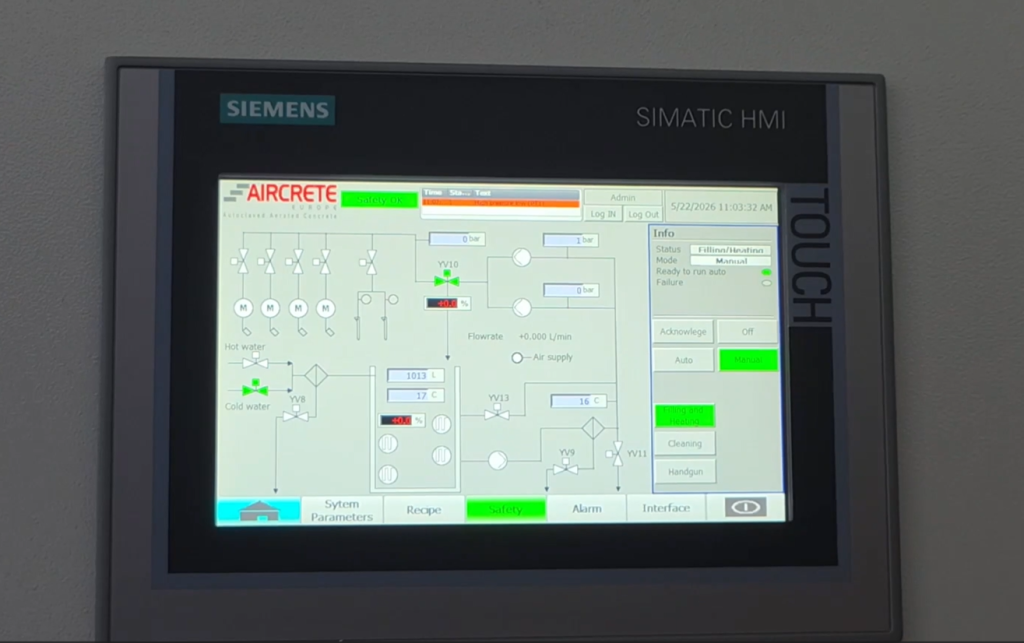
and one-tap access to recipes, cleaning
cycles, and the handheld gun.
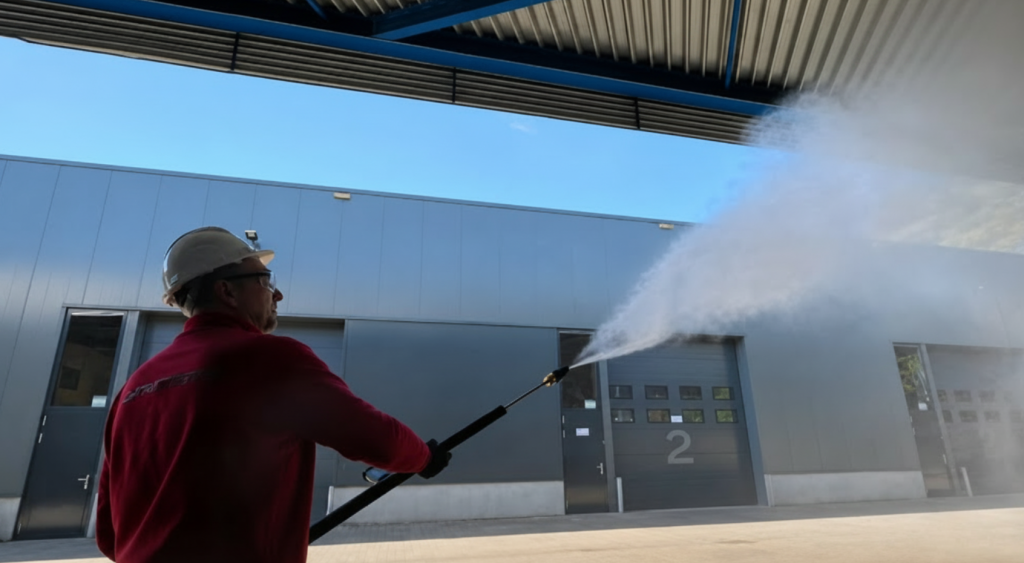
field-testing the
handheld gun,
demonstrating the
reach and pressure
available for cleaning
tasks outside the
mixer tower.
The system ships standard with one handheld gun on a 15-meter hose, with the option to add a second for simultaneous use, for instance cleaning the mixer and casting head at the same time. Every pressure and flow parameter is adjustable through the software, and the system integrates with the mixer tower’s control architecture either through hardwired relay signaling or over a network connection.
Installation itself is designed to be unobtrusive. Commissioning the machine as a whole takes about two days, and none of it requires stopping production. The mixer itself only needs to come offline for a much shorter window, and how long that window is depends on the mixer type. On Aircrete-designed mixers, where the mounting flanges are already in place, the mixer is down for only a few hours. On third-party mixers, where the customer has to weld the flanges into position, that downtime stretches to roughly half a day, depending on the customer’s own welding capabilities. The system is already running successfully across several client facilities, with additional installations underway in new markets.
Viablokk, Hungary: a clear before-and-after
The experience at Viablokk illustrates the real impact on production time impact of the Aircrete High-Pressure Mixer Cleaning System well. Before the system was installed, the plant spent 4-5 hours per week for manual mixer cleaning with production fully stopped. Following installation, cleaning-related downtime was reduced to 5-10 minutes per week. This recovered production time translates directly into greater mixer availability and additional casting capacity without requiring an additional shift or a second mixer. Thus, even on third-party mixers, the Aircrete solution delivers enhanced performance.
A dedicated low-pressure circuit
A separate, complementary innovation addresses a chemical constraint specific to AAC plants: the water used for cleaning is usually recycled condensate, and that condensate carries dissolved silicate. Left unaddressed, silicate deposits clog standard nozzles, typically causing a full blockage within about three weeks. Plants that avoid reusing condensate sidestep the fouling problem but give up the water-recovery benefit; plants that reuse it without solving fouling end up trading that benefit for constant manual maintenance instead.
Aircrete’s answer is a dedicated low-pressure flushing circuit, physically separate from the lines carrying condensate and fed by water filtered to 50 microns. Each mixer is fitted with seven rotating flushing nozzles, up from four in the standard high-pressure configuration, designed to open under pressure and close by spring return.
Running at around 6 bar and using 30–40 liters per cycle, this circuit flushes after every single cake. Because it never encounters condensate, it avoids the silicate fouling that plagued earlier designs, and the same circuit doubles to preheat the mixer with 200 liters of water, without engaging the high-pressure pump at all.
Beyond the mixer tower
Both subsystems have proven useful well beyond the mixer tower itself. The handheld gun is regularly used to clean casting molds during seasonal maintenance, for example removing release oil during winter operation, and to keep the areas around the mixer tower, slurry pits, and casting head clear as well. Taken as a whole, the Dual Pressure Cleaning System is a clear case of engineering built around a specific problem rather than adapted from an adjacent one. By addressing AAC’s particular chemistry and thermal sensitivity directly, from preventing nozzles from clogging with silicate to keeping the mixer at temperature after a stop, it turns cleaning from a production bottleneck into a task that runs alongside casting instead of against it.
Conclusion
The Dual Pressure Cleaning System doesn’t just improve mixer performance, it changes the underlying logic of maintenance on an AAC production floor. Through its distinct set-ups, each adjusting pressure, temperature, and cycle duration to match the exact need of the moment, the system offers a level of versatility no generic cleaning solution could match. That’s precisely its purpose: an alternative built to the specific chemical and thermal demands of the AAC process, rather than equipment adapted from a different kind of concrete altogether.
Its value, though, extends well past cleaning itself. Pre-warming the mixer after a stop, ongoing maintenance of parts exposed to reactive residue, and freeing operators from repetitive work around moving machinery all feed directly into the result that matters most: less production time lost, and less manual labor spent on a task that now runs alongside the process instead of interrupting it. For AAC producers, adopting this technology means rethinking how maintenance coexists with production and efficiency.